Mineralising your water
Get this guide by email
Enter your email and we will send you this guide to keep, plus new mineral guides as we publish them.
Reverse osmosis and distillation pull heavy metals, pesticides, hormones, fluoride and chlorine out of your water. The same filter pulls out the biominerals with them, and biominerals are what let water cross into a cell instead of running straight through you. That is why you can drink two litres of osmosis water a day and still feel dry, thirsty and flat.
This guide covers why purified water stops hydrating, what salt can and cannot do, where biominerals come from, and how to put them back with 10 drops of alcalina in a 200 ml glass.
Reverse osmosis strips out the biominerals that let water reach your cells
Reverse osmosis water is one of the purest waters there is. The filtration removes heavy metals, pesticides, hormones, fluoride, chlorine and other substances that damage health, so it is a real step forward if you are trying to lower your toxic load.
In that search for purity, though, something essential is lost. The system that takes out what harms you also takes out what feeds you.
Water in nature is not only H₂O. As it comes off a spring or a glacier it carries biominerals: complex mineral structures bound to organic matter, natural trace metals and microelements that act as electrical carriers inside the body. These are not inert salts. They are bioactive particles, and they are the reason water is absorbed, held and used by the cell.
Emptied of them, osmosis water loses its bioelectric capacity. It can clean, but it does not nourish and it does not hydrate at cell level. It passes through the body without ever joining it. People who drink only osmosis water often report dryness, constant thirst and low energy, however much they drink.
Real hydration is set by the mineral quality of your water, not only by the litres. When water carries minerals in their natural form, rather than added synthetically, it becomes conductive and restores the electrical signalling between cells. If you use an osmosis or distillation system at home, remineralising the water is not optional.
Salt covers part of the job, humic and fulvic minerals cover the rest
For years the advice has been to add a pinch of salt to your water. Mineral salts such as sodium, potassium and magnesium are genuinely essential for the body's electrical balance, but they are not the only kind of mineral you need.
The difference is in what they are. A salt is an inorganic, static compound, the chemical union of a cation and an anion. It has no biological life: it is mineral matter with no organic structure. Dissolved in water or eaten, it helps hold osmotic balance and electrical conductivity, but it cannot integrate or take part directly in the finer cellular processes.
An organic mineral is a mineral bound to natural organic matter: humic acids, fulvic acids, amino acids, or plant and marine compounds. These biominerals behave completely differently. They cross cell membranes, they are absorbed without forcing the kidneys, and they restore the body's natural electrical communication without creating osmotic overload.
Three different things get called minerals, and your body treats each of them differently.
- Salts, isolated metals and rock. Inorganic and static, with no organic structure to carry them into the cell.
- Synthetic minerals, the kind in most common supplements. Added chemically rather than bound to living organic matter.
- Natural biominerals, built on a fulvic acid structure. Minerals held in a matrix of humic and fulvic acids, amino acids, and plant and marine compounds.
Take in large amounts of salt and the body answers with what is commonly called a hyperosmotic effect. Water moves into the intestine to balance out the salt concentration, and the result is dehydration from the inside: the body sheds water instead of absorbing it. That is literally what is happening when the water you drank comes straight back out.
With biominerals the opposite happens. Instead of forcing a purge they support absorption and intracellular retention of water. They do not irritate and they do not saturate. They feed the cell, carry the signal and hold the balance.
The same thing plays out in a field. Irrigate with salt water and the plants die. Load the same soil with biominerals, the same elements in organic form, and life flourishes. The sodium, magnesium and calcium are still there, but now they sit in a living biological matrix, ready to be taken up by roots, exactly as they are by your cells.
Not all minerals are the same. Salt is only one part of it. Biominerals are what give life back to the water, and to the body.
Plankton and cyanobacteria turn sea salt into minerals your body can absorb
Sea water has become fashionable. It is all over social media, in every health food shop, and now in five litre containers in the supermarket. The interest makes sense: sea water contains more than ninety elements of the periodic table and its composition resembles blood plasma.
In the middle of the boom, almost everyone has forgotten the structure of those minerals. It is not enough for water to contain minerals. What decides whether your body can actually use them is their form, their biological state.
In nature, on land and at sea, there is an invisible conversion at work: inert salts become organic minerals, or biominerals. In soil, microorganisms and living humus do the converting. In the sea, cyanobacteria and plankton do it, tiny organisms that turn mineral salts into biologically active compounds able to feed life.
That is why sea water is not all equal. Sea water that is genuinely nourishing and bioavailable comes from deep zones rich in plankton, the places where microbial life turns salt into cell food. The brands that understand this, such as those collecting in protected areas off Ibiza and Formentera, know that the job is preserving a living structure, not simply bottling salty water.
The rest, however pure or filtered, is salt water. Without that biological step the body can barely take up the minerals, in the same way a plant cannot grow in dead soil. The real work of the sea, like that of the soil, is not in how many minerals are present but in their complexity and their organic structure. Microorganisms are what give the salt life, turning something inert into bioavailable energy.
Humates are the mineral layers ancient seas and forests left underground
Few people know that beneath the surface of the Earth lie layers of biominerals built up over tens of millions of years. They are the result of a slow, exact process: the decomposition, humification and biomineralisation of ancient marine and land ecosystems.
Over whole geological eras the planet ran a continuous cycle. Where there are mountains today there was once sea. Where there is desert now there were dense forests. When those life forms, the algae, plankton, trees and microorganisms, finished their cycle, they were trapped in sediment, and pressure, time and microbial action turned that organic matter into a living mineral network: humates.
These deposits exist at sea and on land. On the ocean floor, microorganisms convert plant matter and the minerals dissolved in salt water into marine humates, rich in trace elements, organic compounds and the microbes that feed plankton. On land, the same process runs under ancient forests, where plant remains mix with mineral salts carried in from old seas. There, over millions of years, terrestrial humates form: black layers rich in humic and fulvic acids, the most bioavailable mineral reserve in nature.
alcalina comes from a deposit where a marine layer and a land layer meet
There are places on the planet where those two worlds joined, zones that were first sea and later forest, leaving extraordinary deposits: stacked strata where a marine layer and a terrestrial layer fused, holding the biomineral wealth of both.
alcalina comes from one of those places. Its origin is a single ancestral reserve where two distinct layers converge, one marine and one terrestrial, formed over more than 30 million years. It concentrates the minerals of the ocean and the plant life of the primordial land in one place.
These humates are, quite literally, the original fertiliser of life. They remineralise soils, regenerate water and return minerals to your body in their purest organic form, the same form that fed the first organisms on the planet. It is not simply a mineral supply. It is a biological reserve millions of years in the making.
Add 10 drops of alcalina to 200 ml of water
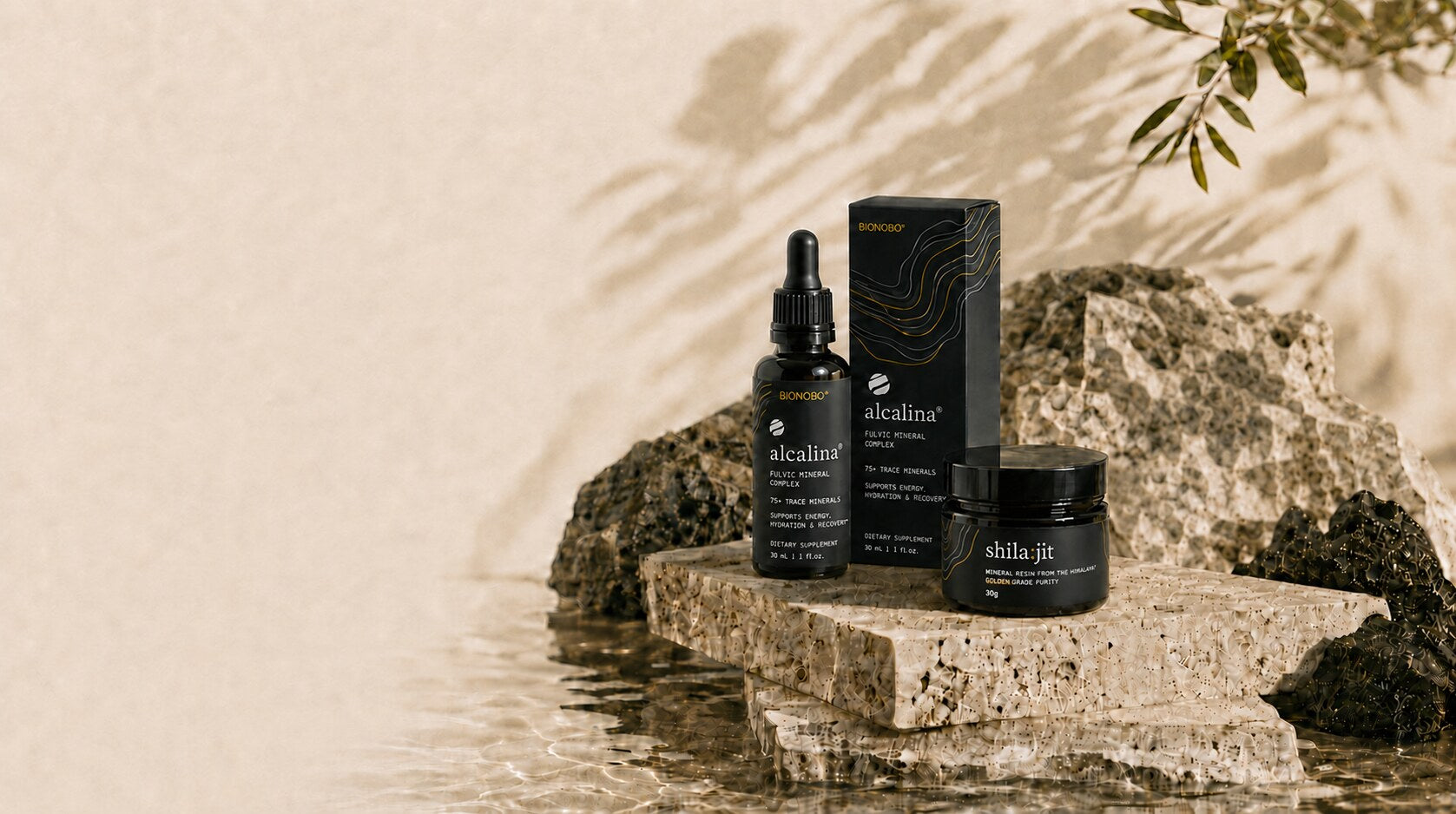
All you need is alcalina, a few drops of living biominerals that give water back its natural structure and its capacity to hydrate deeply. It is the most complete electrolyte there is, it fits in a pocket, and it slots into your day in three ways.
- The serving. 10 drops in 200 ml of water. Let it stand for a few minutes before you drink it, and the water gets its taste and its natural charge back.
- On the move. 2 to 3 drops in each bottle you carry, 500 ml to 1 litre, is enough to turn purified or osmosis water into remineralised, bioactive water.
- Spread across the day. Rather than taking your 10 to 20 daily drops all at once on an empty stomach, split them between the glasses and bottles you drink through the day.
The point is not to add minerals for the sake of it. It is to give the water back its biological intelligence: its molecular structure, its ability to conduct electricity and to enter the cell. Water mineralised with alcalina is water that does more than clean. It feeds, and it restores the signalling between your cells, drop by drop.
Choose alcalina for every day, or shila:jit dorado for a deeper dose
alcalina rehydrates and remineralises with no noticeable taste
alcalina is fulvic biominerals in drops, our gentlest and most tasteless formula, and the one built for daily use. It rehydrates, remineralises and supports the body's cleaning systems steadily and continuously. It suits anyone starting out, and anyone holding a state of ongoing cellular cleansing and hydration. No noticeable taste, easy to use, easy to carry.
shila:jit dorado works on energy, mitochondria and hormone restoration
shila:jit dorado is golden grade shilajit from the Himalayas, a deeper and more intense version, rich in natural humates and rare trace minerals. It acts on energy, mitochondrial function and hormone restoration. It carries the same kind of minerals as alcalina in a different format and from a different region of origin, with a characteristic taste. Prepare it at home, as it needs a few minutes to dissolve.
Start here if you drink osmosis or filtered water
If you have read this far, you are looking for a different way to hydrate: more considered, more natural, and in step with your own rhythms. That is who this guide was written for, and these are the two products behind it.
Five things change when your body rehydrates and remineralises
- Toxic load comes down gradually. The body is helped to clear heavy metals, pesticides and hormone disruptors that interfere with endocrine balance.
- Hormones rebalance naturally. As toxicity falls and liver function improves, the body regains its ability to regulate hormones without outside interference.
- Cells rehydrate and remineralise. Levels of essential minerals such as magnesium, zinc and silica are restored, after years of loss and depleted soils.
- The nervous system settles and sleep improves. A deep cleanse supports rest and emotional steadiness, and reduces hot flushes and anxiety.
- You reconnect with your body. More than a clean out, this is a reconnection with your biology, your natural rhythm and the new energy that comes at this stage.
You can start today. Ten drops of alcalina in 200 ml of water is the whole first step.
These nine suppliers sell organic food, raw dairy, wild salmon and water filters
- Freshvana, organic fruit and vegetables. 100% organic produce, free of pesticides, chemicals and GMOs, from growers committed to regenerative agriculture. www.freshvana.com
- Ecobovis, organic beef. Free range cattle raised under an organic farming and livestock system, shipping to all destinations. www.ecobovis.es
- Ferment9, organic ferments. Live, organic, unpasteurised ferments with no added sugars and no preservatives, made for the microbiome and the immune system. www.ferment9.com
- Crica, unpasteurised pasture dairy. Raw milk and 100% natural dairy from free range cows, goats and sheep. No pasteurisation, no industrial treatment, ethically produced. tienda-crica.pod.coop
- Alkanatur, shower and household filters. An affordable ecological way to purify water at home, with filters made from 100% natural, certified materials. www.alkanatur.com
- Caldo Santa Paciencia, artisan broth. Slow cooked with Kangen water at pH 9.5, organic vegetables and top quality bones. No preservatives, no additives. www.caldosantapaciencia.com
- Kangen Ibérica, Kangen water. Premium water filtration built on Japanese technology. Call +34 644 458 565.
- Alaska Seafood, wild Alaskan salmon. Wild caught, 100% from Alaska, with no feed, no antibiotics and no vaccines. The purest source of real omega 3, free of toxins and heavy metals. alaskaseafood.es
- Amrita Cacao, raw fermented ceremonial cacao. The purest ceremonial grade cacao for daily personal use, on your own or with family and friends. www.amritacacao.com
This guide is for education only and is not medical advice. If you are pregnant, breastfeeding, taking medication or managing a health condition, speak to your doctor or pharmacist before you start. Food supplements do not replace a varied, balanced diet or a healthy lifestyle. Do not exceed the stated serving. Keep out of the reach of young children.