Fulvic acid guide
Get this guide by email
Enter your email and we will send you this guide to keep, plus new mineral guides as we publish them.
Minerals reach your glass in metallic form, and metallic form is not the form a cell can use. The step that converts one into the other happens underground and biologically. Microbes working on decomposing plant matter produce fulvic acid, and fulvic acid dissolves metallic minerals into complexes small enough to cross a cell wall. Where those microbes have been knocked out of the soil, that step stops happening. The mineral still shows up in a water analysis and still sits in the crop, and it still does not get in. This guide covers what fulvic acid does with minerals in water, how to tell a dissolved mineral drop from a suspended one, and how to take alcalina in a glass of water.
Fewer soil microbes leave less fulvic acid in the food you draw minerals from
Every gram of healthy topsoil holds more than four billion microorganisms. The work they do is not marginal: preparing one acre of topsoil consumes the energy equivalent of 10,000 people doing the same job in the same time. Those microbes are what build fulvic acid, and what convert inorganic minerals into the organic mineral forms a plant root can take up.
Excess nitrogen fertiliser, pesticides, erosion and mineral depletion stun and destroy that native microbial life. Once microbial life is inhibited, the humic and fulvic acids go with it. The crop that grows in the remaining soil carries little fulvic acid and few of the mineral complexes that normally travel with it, which is why the plants you eat can be analysed as low in minerals despite the ground beneath them not being empty.
Scientists have identified at least 90 growth and maintenance nutrients that have to be supplied to the body continuously. More than 60 of those are minerals and trace elements. Remineralising soil without restoring fulvic acid does very little, and the same has proved true of remineralising a body: without the fulvic acid the plants we eat are meant to contain, the minerals largely pass through.
Microbes build fulvic acid from decomposing plants, and it carries 60 or more minerals
Geologists call the source material humic deposits. They came from ancient vegetation that never turned into coal or oil, because it was never put under the same pressure and sat close to the surface where microbial activity was abundant. The deposits are rare and scattered across various parts of the world, and some of them are extremely rich in fulvic acid.
Fulvic acid drawn from those deposits typically carries 60 or more different minerals and trace elements dissolved inside its molecular complexes. It has a low molecular weight and it is biologically very active. Researchers treat a water extract of 30 parts per million as a high concentration, which is a useful reference point for how small the quantities involved are.
One caveat runs through the whole literature and it is worth stating early: nobody has ever synthesised fulvic acid, and its molecular structure has still not been identified. Chemists know a great deal about what it does and comparatively little about what it is.
Fulvic acid dissolves metal minerals into a form a cell can absorb
In solution with water, fulvic acid is especially active at dissolving minerals and metals. The metallic mineral dissolves into ionic form and disappears into the fulvic structure, where it becomes biochemically reactive and mobile. What comes out the other side has characteristics quite different from the metallic mineral that went in. This is nature's own chelation, and these are the properties that matter when you are putting minerals into drinking water.
Its molecular weight sits under 700, so it passes through cell walls
Fulvic metal-organic complexes have a low molecular weight and therefore a small molecular size, which lets them penetrate cells to a high degree and pass readily through semi-permeable membranes such as cell walls. These complexes are hundreds of times smaller than a living cell.
It complexes 2 to 6 times more metal than heavier chelating agents
Although fulvic acid usually has a molecular weight below 700, it can complex or chelate two to six times more metal than complexing agents of much higher molecular weight. Russian weathering studies found fulvic acid reached a neutral solution by day 100 of the test and carried on actively chelating for 200 days. The researchers added another 200 days and the chelating action continued. The experiment ended without anyone establishing how long it would have gone on.
It works as an electrolyte, donating or accepting electrons as the cell requires
Fulvic acid is a natural organic electrolyte, meaning a substance soluble in water that can conduct electrical current. It is sometimes available as an electron donor and sometimes as an electron acceptor, depending on which way the cell needs to move to reach balance. Studies of a donor molecule bound to fulvic acid in solution have shown direct evidence of donor-acceptor transfer mechanisms.
It pairs with free radicals carrying either charge
For an antioxidant to bind a free radical, its unpaired electrons must carry an equal and opposite charge to the radical's. Fulvic acid can act either way. Faced with a free radical carrying unpaired positive electrons it supplies the negative charge, and faced with a negatively charged radical it supplies unpaired positive electrons. Depending on the chemistry of the radical, the result is either incorporated into bioavailable nutrients or chelated, mobilised and removed from the body as waste.
It binds pesticides and heavy metals and moves them out as waste
Humic substances interact sorptively with environmental chemicals, either before or after those chemicals reach concentrations toxic to living organisms. The herbicide paraquat is rapidly detoxified by humic substances. At cell level, fulvic acid binds organic contaminants such as pesticides and herbicides, catalyses the breakdown of toxic pollutants, and chelates toxins down to a harmless state so they can be carried out of the organism.
The rest of the properties reported across the research are shorter to state:
- Raises nutrient availability, and extends how long essential nutrients stay in circulation before they are lost
- Moves minerals that are normally difficult to mobilise, iron among them, through plant structures
- Dissolves and transports vitamins, coenzymes, auxins, hormones and natural antibiotics found in soil
- Raises the activity of several enzymes, including alkaline phosphatase, transaminase and invertase
- Increases the permeability of cell membranes and acts as a specific cell-sensitising agent
- Raises DNA content in cells and increases the rate of RNA synthesis
- Complexes vitamins into its own structure and presents them to the cell alongside complexed minerals, which is the state in which the cell can actually use them
- Forms stable water-soluble complexes with monovalent, divalent, trivalent and polyvalent metal ions
- Weathers and dissolves silica on contact, releasing the mineral nutrients locked inside it
- Carries many times its own weight in dissolved minerals and elements
A laser pen shows you whether a mineral drop is colloidal or dissolved
This is a test you can run at home in ten seconds, and it settles an argument that most mineral labelling gets wrong.
Colloids are extremely small solid particles that do not settle out when mixed into a liquid. Because they are undissolved, they reflect light. Shine a laser pen through the bottle. If a distinct beam is visible in the liquid, there are suspended particles in there and the product is colloidal. If no beam appears, the minerals are dissolved into fulvic complexes rather than suspended.
The counter-intuitive part: a fulvic solution carrying hundreds or thousands of parts per million of dissolved minerals throws no beam at all, because there is nothing left in suspension to reflect the light. A weaker colloidal solution will light up and the stronger fulvic one will not. Any product sold as colloidal that produces no visible beam is mislabelled. A genuine fulvic product also tends to identify itself by taste, through an unusual acidic note specific to fulvic acids.
Colloidal mineral particles stay metallic and too large for cell walls
A colloidal mineral is one that has been so altered that it no longer passes through cell walls or other organic membranes.
Dr Royal Lee
Remington's Pharmaceutical Sciences describes colloidal mineral particles as consisting of many aggregates, each aggregate containing many molecules. That puts colloidal minerals at particle sizes many times larger than other mineral forms, and it is on size grounds that the body does not absorb them. True colloidal minerals remain in metallic form, only smaller.
Plants neither produce nor use colloidal minerals. Through photosynthesis a plant makes sugars and exudes some of them at root level; soil microorganisms feed on those polysaccharides, multiply, and return soluble organically complexed minerals that the plant can actually use. Destroy the microorganisms and that exchange stops.
Buyer caution belongs here too. Some preparations on the market are heavily diluted or adulterated. Sulphuric and other acids have been added to extraction vats to raise apparent dissolved solids, and some preparations drawn from certain ancient lake beds could be very unsafe. Most products labelled colloidal contain some fulvic acid, often at low or inconsistent volume and stability, and are labelled colloidal by suppliers who do not know what they have.
The same sample returns different mineral counts at different labs
Anyone comparing mineral drops on assay numbers should know how unreliable those numbers are. One distributor sent identical samples of a mineral solution to several laboratories for conventional mass spectrometry. The total number of minerals detected ranged from under 40 to more than 50 on the same sample. The quantity reported for each individual mineral varied by 50 to 60 per cent between labs.
Mass spectrometry, atomic absorption and fire assay all hit the same wall, because the molecular structure of fulvic and humic acids has never been identified. Something in the complexes masks elements from view in one run and reports absurdly high readings in the next. The key to that puzzle will probably arrive shortly after someone works out the molecular structure.
The practical conclusion, in the words of one producer, T.J. Clark and Company: using a metals assay as a tool for selecting a trace mineral product for human consumption is not a valid use, except to show levels of potentially toxic materials.
Trace means parts per million, and the same element turns toxic in bulk
Poisons in small doses are the best medicines, and the best medicines in too large doses are poisonous.
William Withering
Essential trace elements are essential only in minute quantities. Used in excess they become poison, and that holds for major elements as well: iron in excess is toxic. Nutrients also work as a team, so an abnormal concentration of any one element produces a metabolic imbalance rather than a benefit.
Fulvic acid carries complexed minerals at trace levels only, at concentrations similar to those found in healthy plants grown in mineral-rich soil under good organic conditions. For scale, most food crops carry 20 to 200 parts per million of aluminium as a matter of course. Mint leaves carry 160 ppm, spinach 102 ppm, beetroot leaves 72 ppm, various seaweeds 40 to 98 ppm and beans 1,640 ppm. These are ordinary plant foods, not contaminated ones.
Deficiency does as much damage as excess. Too little zinc in the diet brings loss of appetite, a reduced sense of taste and smell, slow wound healing and skin lesions. Some elements also hold each other in check: mercury and selenium are metabolically antagonistic, so each protects against poisoning by the other.
Two further observations from the record on fulvic complexes. Cells accept or reject minerals at their own discretion when those minerals are presented as organic fulvic complexes, because in that form they act as electrodes in an electrolytic solution rather than simply as nutrients. And fulvic mineral solutions have been ingested by people for many years without ever being shown to cause toxic mineral accumulation in humans.
Kervran's hens built eggshell calcium out of plant silica
Calcium supplementation has a poor record. People taking large amounts of calcium from water, milk and other mineral sources show little improvement in deficiency, and researchers looking for the reason have kept arriving at silica.
Professor Louis C. Kervran, a former French health minister, ran the work with the help of French state laboratories. Hens deprived of calcium entirely laid soft-shelled eggs. When mica was added to their diet, hard calcium-rich shells returned. Mica contains no calcium at all; it contains potassium and silica. Analysis of incubated hen eggs showed the hatched chicks contained 400 per cent more calcium than the egg they came from, and the silica-rich membrane that had separated yolk and white from the shell before incubation was gone afterwards. In further controlled animal work, animals with broken bones given plant silica healed faster and stronger than a control group low in plant silica and high in mineral calcium.
Kervran and his collaborators concluded that the calcium animal cells need rarely comes from mineral calcium, and is instead the product of biological transmutation from silica and other elements. They also found that plant silica converts to mineral silica as plants age or over-ripen, and that mineral silica decalcifies the body. Only young, fast-growing plants carry soluble plant silica, which is why the source of any silica supplement matters and why commercial plant silica of unknown plant age is unreliable.
Fulvic acid is particularly good at dissolving organic silica, and it supplies the electrolyte conditions under which these mineral reactions take place inside the cell. Patients with degenerative disease almost always show a considerable silica deficiency, and geographic areas rich in plant silica report lower cancer rates than areas with high calcium intake and low soluble silica.
Take 10 drops of alcalina in 200 ml of water
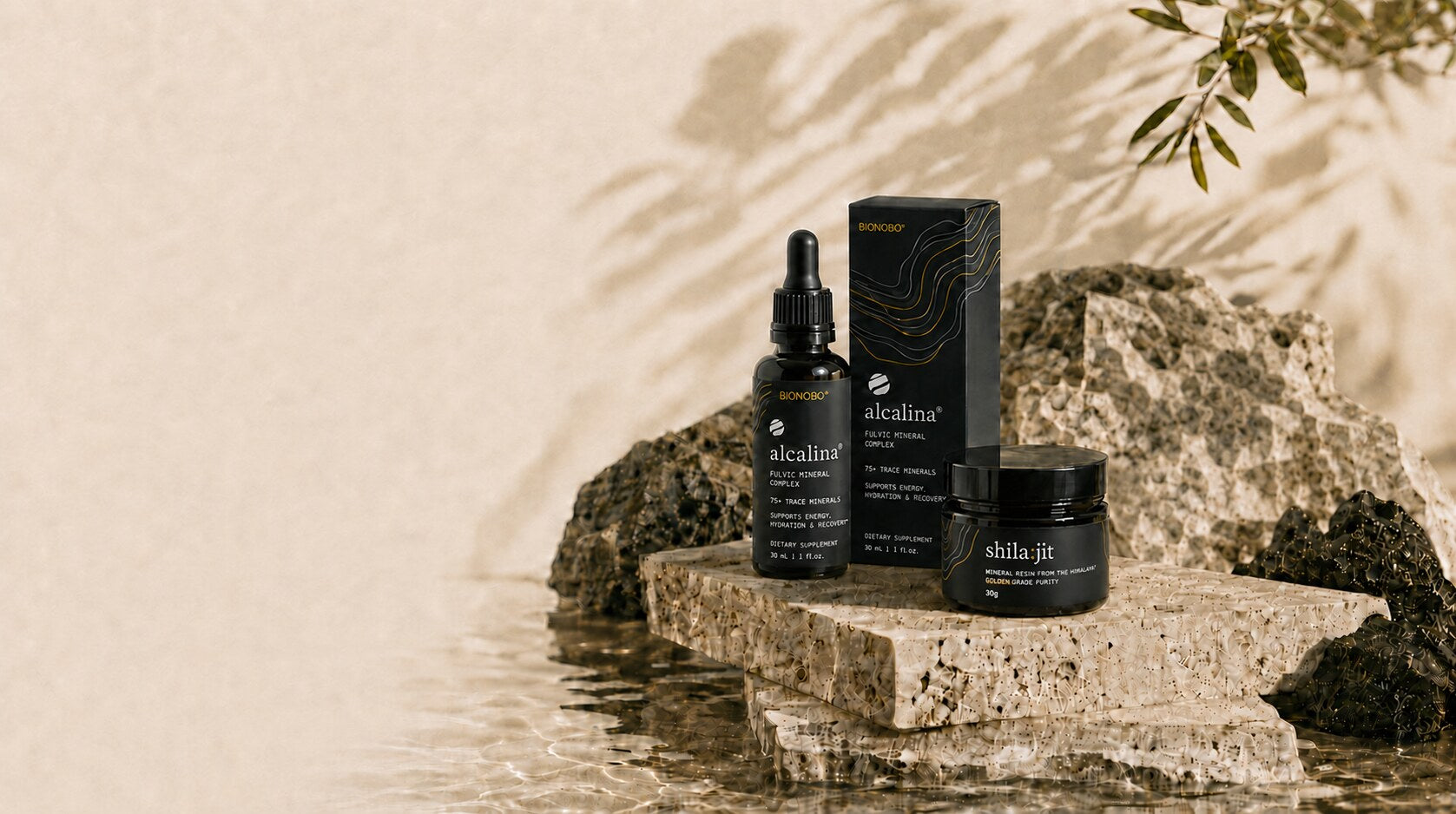
Alcalina is the fulvic mineral concentrate in the Bionobo range, and water is where it goes. The dose is small on purpose, for the reasons set out above: fulvic complexes work at trace concentration, and more is not better.
- Fill a glass with 200 ml of water. Filtered or spring water is fine, and so is tap water.
- Add 10 drops of alcalina and stir or swirl.
- Drink it. Expect a faint acidic note, which is characteristic of fulvic acids rather than a fault.
Children take 5 drops in 150 ml
Halve the drops and reduce the water to 150 ml for children. Do not exceed the stated dose for either adults or children.
If you are working through a wider mineral protocol rather than only remineralising your drinking water, the beginner detox guide is the next page to read.
Morningstar Minerals published the research this guide draws on
The material summarised here comes from Fulvic Acid: The Miracle Molecule, published by Morningstar Minerals of Farmington, New Mexico, copyright 1997 Fulvica BioScience by permission of Kenneth D. Westwood. It runs to 45 pages and around 120 footnoted references, drawing on soil science, agronomy and clinical literature. The full source and its references sit with the publisher at www.msminerals.com, and their reference desk can be reached at jpm@msminerals.com.
This guide is published for education only and is not medical advice. If you are pregnant, breastfeeding, taking medication or managing a diagnosed condition, speak to a doctor or qualified health professional before starting any supplement. Food supplements are not a substitute for a varied and balanced diet and a healthy lifestyle. Do not exceed the stated dose. Keep out of the reach of young children.